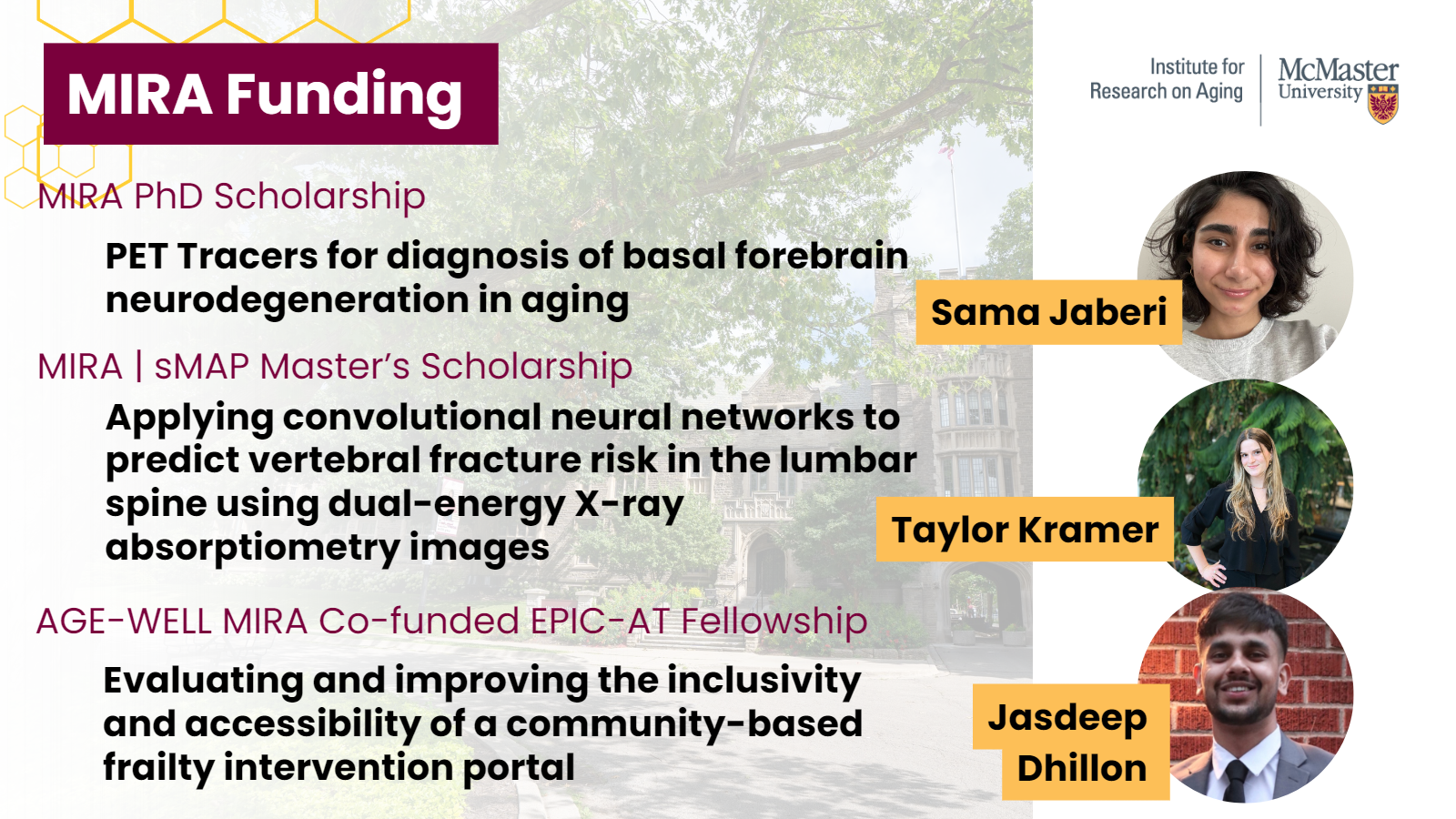
Applying convolutional neural networks to predict vertebral fracture risk in the lumbar spine using dual-energy X-ray absorptiometry images


2024 | MIRA | sMAP Master’s Scholarship
Awarded to: Taylor Kramer
Mechanical and Biomedical Engineering,
Faculty of Engineering & Faculty of Health Sciences
Supervisor: Cheryl Quenneville
Mechanical Engineering, Faculty of Engineering
Summary
The objective of this research project is to use patient characteristics (age, sex, fracture history, etc.) and lumbar spine images to determine an individual’s risk of sustaining an osteoporotic vertebral compression fracture within a five-year period.
The end goal of this project is to develop a clinical tool that uses machine learning principles to quantify fracture risk, ensuring that the appropriate clinical preventative measures can be implemented. Machine learning is a powerful tool that can be used to identify combinations of features associated with fracture, and previous research studies have used methods in artificial intelligence to discover pixel patterns and trends from images.
To develop the algorithm, labeled images will be used to develop the training, validation, and test sets that will then be applied to a convolutional neural network capable of recognizing patterns that can be used to predict an individual’s probability of sustaining a vertebral fracture.

Related News
Related Publications
No related publications to display.