‘Aging doesn’t happen in silos.’ At the McMaster Institute for Research on Aging, researchers from all faculties work together to study the complex, interconnected factors affecting how we age.
Original story by McMaster News, written by Lisa Polewski
Everyone is aging, but many are not aging well. That’s why researchers at McMaster are focused on what drives the differences among older adults, so more people can live longer and healthier lives.
An important part of that research is the Canadian Longitudinal Study on Aging (CLSA), a 20-year study collecting detailed data about more than 50,000 Canadians.
It’s the largest and most comprehensive study of its kind in the country and has been a vital global research resource since its launch in 2011.
Researchers are collecting extensive information on physical health and biology, cognitive function, mobility, and social and environmental contexts, creating an unparalleled foundation for understanding how people age over time.
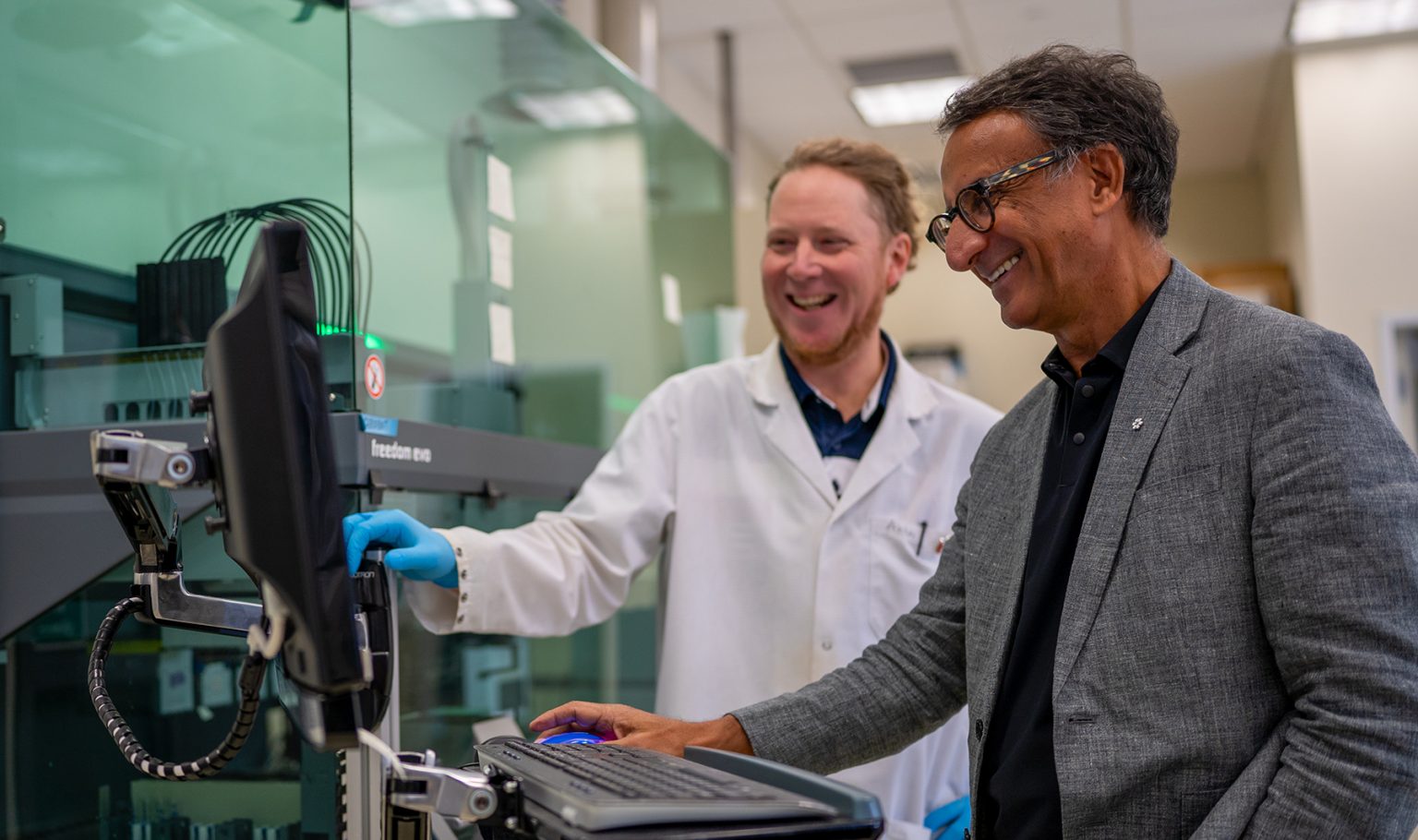
“We have collected data that is unmatched in its depth and scope, and researchers from McMaster and across Canada are using the data to produce science of the highest quality,” says Parminder Raina, Lead Principal Investigator of the CLSA and Scientific Director of the McMaster Institute for Research on Aging (MIRA).
“That is why researchers from around the world are coming to CLSA.”
Funded by the Government of Canada, the Canadian Institutes of Health Research, and 11 partner universities, the CLSA is one of the largest national investments in aging research globally.
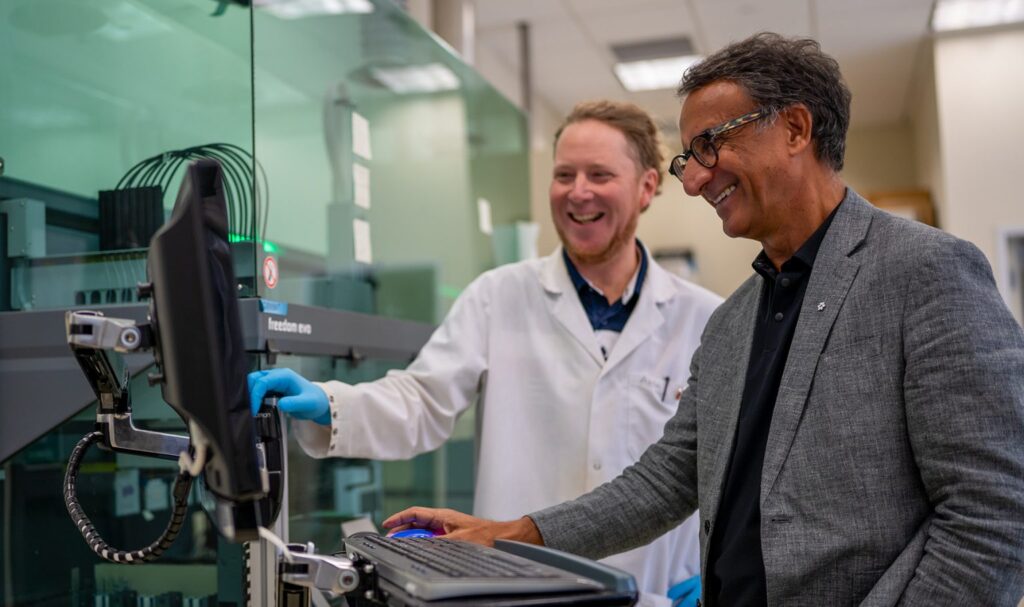
McMaster serves as the study’s home base, housing its co-ordination centre, a major data collection centre and the Biorepository and Bioanalysis Centre, the national hub for biological sample storage and analysis.
The study is a cornerstone of McMaster’s leadership in aging research and a foundational platform that supports MIRA’s mission to improve the lives of older adults through interdisciplinary research, innovation and meaningful partnerships.
Since launching in 2016, MIRA has brought together researchers from all six McMaster faculties to address aging as a complex, interconnected process that includes biological, clinical, psychological, social and environmental factors.
It’s an approach that reflects the lived reality of aging and enables solutions that move beyond traditional disciplines.
“Aging does not happen in silos,” says Raina.
“If you focus on only one dimension, you miss critical drivers of health and well-being. MIRA brings these perspectives together to generate knowledge that can be translated into real-world impact.”
Older adults, caregivers and communities are key partners in the research underway at MIRA to ensure discoveries lead to solutions that are relevant, usable and equitable.
“If interventions or technologies are not designed and tested with older adults in mind, they are unlikely to be effective,” Raina explains. “Engagement ensures that our research truly improves lives.”
Knowledge translation and public impact
The Optimal Aging Portal is MIRA’s flagship knowledge translation and public engagement platform, providing trustworthy, plain-language information on aging, grounded in the latest research from McMaster and global partners.
“Generating evidence is only part of our responsibility,” says Raina. “We also have a responsibility to ensure people understand and use that evidence in their daily lives. The Optimal Aging Portal allows us to do exactly that.”
The portal supports older adults, caregivers, health professionals, community organizations and policy makers through articles, videos, webinars, and curated resources. It’s a critical piece of MIRA’s commitment to making science more accessible to the public.
Mobility as a foundation for healthy aging
Mobility in all its forms is one of the strongest predictors of independence, health, and quality of life for older adults.
MIRA, internationally recognized for mobility research, is following more than 1,500 participants over several years using wearable devices as part of the McMaster Monitoring My Mobility or MacM3 study.
It is the first study of its kind, incorporating both GPS and accelerometers, to explore how and why people lose mobility as they age and identify early warning signs for serious health issues down the road.
The study, led by Marla Beauchamp, the Canada Research Chair in Mobility and Aging and an associate professor in Rehabilitation Science, is supported by an interdisciplinary team of McMaster researchers.
Beauchamp is also working with the World Health Organization to develop global mobility metrics for older adults and guidance for population health surveillance.
“From a scientific standpoint, we need standardized, objective measures of mobility,” explains Raina. “Wearable technologies allow us to generate data that can be compared across studies, populations, and health systems.”
One of MIRA’s flagship interdisciplinary research programs is EMBOLDEN (Enabling Mobility, Balance, and Resilience in Older Adults), which aims to understand and address the complex factors that contribute to mobility decline, falls, and loss of independence.
Led by Rebecca Ganann, an associate professor of Nursing, the program emphasizes translation and implementation of data into practice, community programs and policy.
Intergenerational research and functional aging
Aging can vary wildly across different generations, with some people more susceptible to cardiovascular disease, cancer, mental health disorders, diabetes, and dementia than others — despite sharing the same risk factors.
The MIRA-iGeN (Intergenerational Study on Aging) examines how relationships, resources, and experiences across generations shape health, resilience, and aging trajectories.
Led by Raina and Andrea Gonzalez, an associate professor in the Department of Psychiatry, the study explores how family structure, caregiving, social connection, education, work, and socioeconomic conditions influence aging.
“Understanding those connections allows us to design interventions that support individuals, caregivers, and communities together,” says Raina.
MIRA leads major programs in brain health and cognitive aging, leveraging longitudinal data, biomarkers, neuroimaging, and digital assessments to identify early risk factors and protective pathways for cognitive decline and dementia.
The institute also advances research on pain and musculoskeletal health, recognizing chronic pain as a major driver of disability, reduced mobility, and diminished quality of life among older adults.
Equity, Community Partnership, and the MIRA | Dixon Hall Centre
MIRA’s commitment to equity has led the institute to partner with Dixon Hall, a community-based organization serving vulnerable older adults in Toronto’s downtown east end — one of the most culturally and linguistically diverse urban areas in Canada.
“Thirty-four languages are spoken within a 13-kilometre radius of Dixon Hall,” says Raina.
“Many residents face challenges related to housing, health-care access, and the built environment. These populations have historically been underrepresented in research and addressing that gap is essential.”
Directed by Beauchamp, the MIRA | Dixon Hall Centre grounds research in lived experience and generates evidence to inform more inclusive services, policies, and models of care.
Preparing for an aging world
By 2035, nearly one quarter of Canada’s population will be over the age of 65, a demographic shift mirrored globally. Raina views this as a success of public health and medicine — but one that requires evidence-based, equitable responses.
“Understanding aging is essential,” says Raina. “But real impact comes when we change trajectories, helping people remain mobile, independent, and engaged as they age. That is where MIRA has become a global leader.”